
What is a “trigger” finger?
Flexor tendons are surrounded by a sheath that allows the tendons to glide easily over joints, bones and other tendons. Tendons are held in position by a series of fibrous bands, known as pulleys. These pulley’s lie over the top of the tendon sheath and attach to bone.
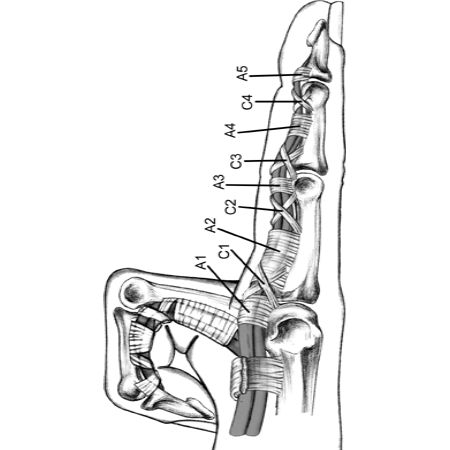
When the finger is unable to glide because of a nodule that catches at the site of the first pulley. The finger may lock or suddenly trigger, extending with a snap.
Trigger finger most commonly occurring in middle aged women, and more commonly in people with Rheumatoid arthritis, Diabetes Mellitus, Dupuytren’s disease and repetitive trauma. Trigger finger can often co-exist with Carpal Tunnel syndrome.
Stages of triggering
| STAGE | SYMPTOMS: |
| 1 | Normal |
| 2 | A painful palpable nodule |
| 3 | Triggering |
| 4 | The PIPJ locks into flexion and is unlocked with active PIPJ extension |
| 5 | The PIPJ locks into flexion and is unlocked with passive PIPJ extension |
| 6 | The PIPJ remains locked in a flexed position |
Treatment
- Heat can be applied for general pain and ice can be used for general inflammation
- Your therapist can provide you with a custom thermoplastic splint to help prevent your finger from triggering.
- Steroid injection/iontophoresis
- Failing the above, a referral can be made for a surgical consult to release the pulley providing resistance to the tendon.